

The Irish Brigade and St. Patrick’s Day in the American Civil War


Few formations in American military history possessed a more distinct cultural identity than the Irish Brigade of the Union Army. Established during the early years of the American Civil War, the brigade functioned as both a combat unit and a symbol. It embodied the aspirations of thousands of Irish immigrants who had crossed the Atlantic to escape famine, poverty, and political repression. Many arrived in the United States with only their labor to contribute. When war erupted in 1861, they offered their lives in service.

The Irish Brigade was formed under the leadership of Thomas Francis Meagher, a former Irish revolutionary and exile from the unsuccessful Young Ireland uprising of 1848. Meagher recognized the significance of symbolism and collective identity. He organized regiments primarily composed of Irish immigrants, most notably the 69th New York Infantry, as well as the 63rd and 88th New York. Subsequently, the 28th Massachusetts and the 116th Pennsylvania joined the brigade, further reinforcing its distinct Irish Catholic identity and separating it from most other Union units.

The soldiers of the Irish Brigade marched under distinctive green battle flags rather than the standard blue regimental colors. These silk banners were embroidered with the golden Irish harp, often accompanied by the sunburst of Erin. Amid the smoke and confusion of American battlefields, the green flags served as unmistakable markers of the Irish Brigade's presence.
The brigade rapidly developed a reputation for exceptional courage. During the Battle of Antietam in September 1862, the Irish Brigade participated in one of the war’s most violent engagements. Ordered to assault Confederate positions along a sunken farm road later known as Bloody Lane, Meagher’s men advanced through intense rifle and artillery fire. Brigade chaplain Father William Corby notably offered general absolution to the Catholic soldiers before the assault, a moment commemorated in both art and historical memory.
The Irish Brigade suffered over five hundred casualties at Antietam. Nevertheless, their reputation for bravery continued to grow.
Three months later, at the Battle of Fredericksburg, the brigade was once again positioned at the center of one of the war’s most intense assaults. Union forces attempted to storm Confederate positions entrenched along Marye’s Heights. The Irish Brigade advanced directly toward a stone wall defended by experienced Southern infantry.
Contemporary observers noted the green flags advancing steadily across open ground despite devastating fire. Confederate soldiers later acknowledged the courage displayed by the Irish Brigade. One Southern officer reportedly stated that no men had ever charged more bravely or with greater certainty of death.
Nearly half of the brigade became casualties during that assault.
By 1863, the Irish Brigade had been nearly destroyed by combat losses. Replacements filled the ranks, but the earliest core of Irish immigrants had been heavily reduced. Even so, the traditions that defined the brigade remained powerful.
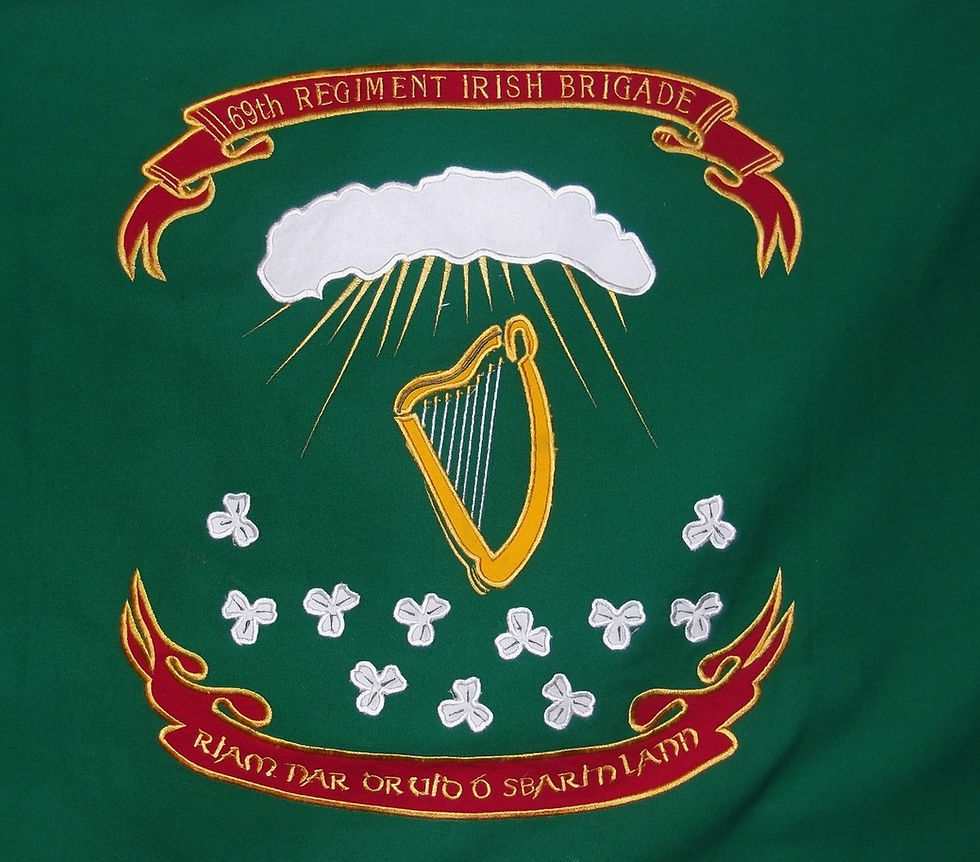
Among these traditions, St. Patrick’s Day held particular significance.
For Irish soldiers in America, the holiday carried enormous emotional meaning. It connected them to a homeland many had left under desperate circumstances. It also reminded them of a shared cultural identity that remained strong even while they fought in a new country’s war.
When the campaigning season permitted, Irish soldiers observed the holiday with ceremonial activities. Shamrocks were pinned to caps or uniforms when available, and green ribbons adorned rifles and cartridge boxes. Officers occasionally authorized small whiskey rations in recognition of the occasion. The brigade band performed Irish songs, and the green banners were prominently displayed above the camps.
These celebrations passed beyond mere nostalgia and served a significant military function. In an army composed of immigrants, farmers, laborers, and urban workers, identity and cohesion were essential. The Irish Brigade exemplified both qualities.
A shared heritage fostered bonds of loyalty that sustained the brigade despite severe casualties. Soldiers did not fight only for the Union, but also for one another, for their regiments, and for the honor of Ireland.
Many Irish immigrants believed that military service would demonstrate their loyalty to their adopted country. During the mid-nineteenth century, Irish Catholics frequently encountered prejudice and discrimination in American society. Service in the military provided a potential path to acceptance and respect.
The Irish Brigade exemplified this pursuit of acceptance and recognition.
Their sacrifices at Antietam, Fredericksburg, Chancellorsville, and Gettysburg demonstrated that Irish immigrants were willing to fight and die for the United States. Newspapers across the North praised their courage. Even their enemies recognized their reputation.
In the later years of the war, the brigade underwent significant changes. Casualties and subsequent reorganizations diminished its original Irish composition. Nevertheless, the legend persisted. The green flags, the harp of Erin, and the memory of those arduous charges became integral to Civil War history.
For the Irish soldiers who marched under these banners, St. Patrick’s Day represented more than a celebration. It symbolized the transition from exile to belonging. Amid the mud and smoke of American battlefields, individuals who had fled famine and oppression demonstrated their commitment as warriors of a new nation.
The narrative of the Irish Brigade remains one of the most powerful examples of immigrant identity influencing military history.
Bibliography
Bilby, Joseph G. Remember Fontenoy! The 69th New York and the Irish Brigade in the Civil War. New York: Savas Beatie, 2006.
Conyngham, David Power. The Irish Brigade and Its Campaigns. New York: Fordham University Press, 1994. Originally published 1867.
Corby, William. Memoirs of Chaplain Life: Three Years with the Irish Brigade in the Army of the Potomac. Notre Dame, IN: University of Notre Dame Press, 1893.
Meagher, Thomas Francis. Speeches on the Irish Brigade and the Civil War. New York: D. & J. Sadlier & Co., 1867.
McPherson, James M. Battle Cry of Freedom: The Civil War Era. New York: Oxford University Press, 1988.
Miller, Kerby A. Emigrants and Exiles: Ireland and the Irish Exodus to North America. New York: Oxford University Press, 1985.
O’Reilly, Francis Augustín. The Fredericksburg Campaign: Winter War on the Rappahannock. Baton Rouge: Louisiana State University Press, 2003.
Sears, Stephen W. Landscape Turned Red: The Battle of Antietam. Boston: Houghton Mifflin, 1983.


Comments