


If the tanks succeed, then victory follows. Heinz Guderian
Armored Vehicles
AMX-30


The AMX-30 was a French main battle tank introduced in 1966 and developed by GIAT Industries as France’s primary armored vehicle during the Cold War. Designed with a focus on mobility and firepower rather than heavy armor, the tank reflected French doctrine that emphasized speed, maneuverability, and long-range engagement over maximum protection. The AMX-30 was armed with a 105 mm rifled gun, capable of firing high-velocity anti-tank rounds and specialized ammunition, and it operated with a four-man crew.
Weighing significantly less than many contemporary Western tanks, the AMX-30 typically weighed between 36 and 39 tons and was powered by a 720-horsepower diesel engine, giving it excellent mobility and a top speed of about 65 km/h. Although its armor protection was lighter than that of some NATO counterparts, the tank’s firepower, speed, and advanced optics made it a capable battlefield platform. The AMX-30 served for decades in French armored units and was widely exported, becoming one of the most recognizable European tank designs of the Cold War.
Manufacture:
105 mm
Caliber:
GIAT Industries
Weight:
36–39 t
AbramsX


The AbramsX is a next-generation concept main battle tank developed by General Dynamics Land Systems and first publicly demonstrated in 2022. Designed as a technology demonstrator rather than a production vehicle, AbramsX explores potential future upgrades for the long-serving M1 Abrams. The design incorporates a hybrid-electric power system, an uncrewed turret, and advanced automation intended to reduce the crew from four to three while improving fuel efficiency, sensor capability, and battlefield networking.
The vehicle retains a 120 mm main gun but adds modern digital systems such as AI-assisted target recognition, drone integration, and active protection systems to defend against missiles and loitering munitions. AbramsX reflects the U.S. Army’s broader shift toward networked, sensor-rich armored warfare, emphasizing survivability, reduced logistical burden, and the integration of unmanned systems alongside traditional armored formations.
Manufacture:
120 mm
Caliber:
General Dynamics Land Systems
Weight:
~55 tons
Altay


The Altay is Turkey’s modern main battle tank, developed to provide the Turkish Army with an indigenous armored platform capable of replacing older Cold War vehicles. The program was led by Otokar during early development and later transferred to BMC for production. Drawing on technology cooperation with Hyundai Rotem, the Altay incorporates design features influenced by the K2 Black Panther while integrating Turkish-developed armor systems, electronics, and fire-control technology.
The tank is armed with a 120 mm smoothbore cannon and uses advanced composite armor, modular protection packages, and modern battlefield electronics to improve survivability and target engagement capability. Powered by a high-output diesel engine producing roughly 1,500 horsepower, the Altay is designed to achieve strong mobility and a top speed of about 65 km/h. Intended as the centerpiece of Turkey’s armored forces, the Altay represents a major step in the country’s effort to develop domestically produced armored vehicles and reduce reliance on foreign tank imports.
Manufacture:
120 mm
Caliber:
BMC
Weight:
65 tons
Black Eagle (Object 640)


The Black Eagle (Object 640) was a Russian prototype main battle tank developed in the late 1990s by the Omsktransmash design bureau as an experimental successor to the T-80 family. The tank was first publicly displayed in 1997 at a defense exhibition in Omsk and attracted attention for its distinctive extended turret bustle, which housed an improved autoloader and ammunition storage system designed to increase crew survivability. The vehicle retained the traditional 125 mm smoothbore cannon used on many Russian tanks and was intended to incorporate advanced fire-control systems and improved armor protection.
Although the Black Eagle demonstrated several promising design features, including enhanced composite armor and explosive reactive armor, the project never entered production. Financial constraints in post-Soviet Russia and shifting defense priorities led to the program’s cancellation in the early 2000s. Despite its limited development, the Black Eagle remains an important example of Russian experimental tank design and illustrates the technological direction Russian engineers were exploring as they sought to modernize armored forces after the Cold War.
Manufacture:
125 mm
Caliber:
Omsktransmash
Weight:
~48 tons
Churchill Mk IV


The Churchill Mk IV was a British infantry tank used extensively during the Second World War. Introduced in 1942, it was designed with extremely heavy armor and excellent climbing ability, allowing it to support infantry during assaults on fortified positions and difficult terrain. The Mk IV version was the most widely produced variant of the Churchill series and mounted a 6-pounder (57 mm) anti-tank gun, which provided significantly improved firepower compared with earlier models.
Although the Churchill was slower than many contemporary tanks, its thick armor and rugged suspension made it highly effective in defensive and assault roles. The tank served in several major campaigns, including North Africa, Italy, and Northwest Europe, where its ability to traverse obstacles and absorb heavy punishment earned it a strong reputation among Allied crews.
Manufacture:
75
Caliber:
Vauxhall
Weight:
40
M4 Sherman

The M4 Sherman was the primary medium tank used by the United States and Allied forces during the Second World War. Introduced in 1942, it was designed to be reliable, easy to produce, and mechanically simple to maintain in large numbers. The Sherman was typically armed with a 75 mm or 76 mm main gun and operated with a five-man crew, providing a balanced combination of firepower, mobility, and crew efficiency.
More than 49,000 Shermans were built during the war, making it one of the most widely produced tanks in history. The tank served in nearly every major Allied campaign, including North Africa, Italy, Western Europe, and the Pacific, and was also supplied to Allied nations through the Lend-Lease program. While it faced challenges against heavier German tanks, the Sherman’s reliability, numerical advantage, and versatility made it one of the most important armored vehicles of the war.
Manufacture:
75
Caliber:
Various
Weight:
30




Panzer II


The Panzer II was a German light tank introduced in 1936 and used extensively during the early campaigns of the Second World War. Originally intended as a temporary design while more advanced tanks were developed, it was armed with a 20 mm autocannon and operated with a three-man crew. The tank offered good mobility and reliability but had relatively thin armor and limited firepower.
The Panzer II played an important role during the invasions of Poland in 1939 and France in 1940, forming a significant portion of Germany’s early armored forces. As heavier Allied and Soviet tanks appeared, the vehicle became increasingly obsolete for front-line combat, but its chassis remained useful and was later adapted for reconnaissance vehicles and self-propelled guns.
Manufacture:
20 mm
Caliber:
MAN / Daimler-Benz
Weight:
8.9 t
PzKpfw 38(t)

The Panzerkampfwagen 38(t) was a light tank originally developed in Czechoslovakia as the LT vz. 38 by the company ČKD before the German occupation of the country in 1939. After Germany seized control of Czechoslovakia, the Wehrmacht adopted the design into service as the PzKpfw 38(t), with the “(t)” indicating its Czech origin (tschechisch). The tank proved highly reliable and mechanically robust, which made it valuable during the early campaigns of the Second World War. Armed with a 37 mm main gun and several machine guns, the vehicle weighed just under 10 tons and carried a four-man crew. Its combination of mobility, reliability, and adequate firepower made it an effective light tank during the early years of the war.
The PzKpfw 38(t) played a significant role in German armored formations during the invasions of Poland in 1939, France in 1940, and the opening stages of Operation Barbarossa in 1941. However, as the war progressed and heavier Soviet tanks such as the T-34 appeared on the battlefield, the 38(t)’s light armor and small-caliber gun became increasingly inadequate for front-line combat. Although the tank itself was gradually withdrawn from frontline service, its reliable chassis proved extremely valuable. Germany used the design as the basis for several successful armored vehicles, including the Marder III tank destroyer and the Jagdpanzer 38(t) “Hetzer,” extending the operational life of the platform well beyond the tank’s original role.
Manufacture:
37 mm
Caliber:
ČKD / Škoda
Weight:
9.7 t
Stridsvagn 101


The Stridsvagn 101 (Strv 101) was Sweden’s designation for the British-built Centurion Mk.10 main battle tank, introduced into Swedish Army service in 1958 as part of a broader modernization of the nation’s armored forces during the Cold War. Sweden had relied primarily on domestically produced tanks after the Second World War, but the rapid improvements in Soviet armor during the 1950s convinced Swedish planners that an interim solution was needed while indigenous designs matured. The Centurion offered exactly what Sweden required: strong armor protection, excellent cross-country mobility, and a powerful main gun. The Strv 101 retained the Centurion’s 105 mm L7 rifled gun, one of the most respected tank guns of its era, capable of defeating most contemporary Soviet armor. With a combat weight of roughly 51 tons and powered by a 650-horsepower Rolls-Royce Meteor engine, the tank balanced firepower and durability with acceptable mobility across Sweden’s varied terrain of forests, marshlands, and rocky ground.
In Swedish service, the Strv 101 quickly gained a reputation for reliability and battlefield effectiveness. Swedish crews valued the Centurion’s stable firing platform and accurate gun, which allowed effective engagement at longer ranges than many earlier tanks. Although later Swedish armored doctrine would shift toward more unconventional designs such as the turretless Stridsvagn 103, the Strv 101 remained an important backbone of Sweden’s armored brigades throughout the early Cold War period. Over time, many vehicles received upgrades in fire control equipment, communications, and survivability improvements, ensuring the type remained relevant until more advanced variants and indigenous designs entered service. The Strv 101 therefore represents a key transitional step in Swedish armored development, bridging the gap between imported wartime technology and Sweden’s later generation of uniquely domestic tank designs.
Manufacture:
105 mm
Caliber:
Bofors / Landsverk
Weight:
51 t
T-55AM Merida


The T-55AM “Merida” was a Polish modernization of the Soviet T-55 main battle tank, introduced in 1985 to extend the operational life of Poland’s large fleet of Cold War armored vehicles. The upgrade focused on improving fire control, protection, and battlefield survivability while retaining the reliable mechanical foundation of the original T-55. One of the most significant additions was the Merida fire-control system, which incorporated a laser rangefinder, ballistic computer, and improved gun stabilization. These improvements significantly increased first-shot accuracy and allowed Polish crews to engage targets more effectively at longer ranges.
The modernization also included additional armor protection, often incorporating composite elements and sometimes explosive reactive armor to improve resistance against shaped-charge weapons and anti-tank missiles. The tank retained the 100 mm D-10T rifled gun, supported by the T-55’s traditional four-man crew layout and powered by a 581-horsepower diesel engine. While the upgrade could not fully match the capabilities of newer Western main battle tanks, the T-55AM Merida allowed Poland to maintain a credible armored force during the late Cold War by improving the combat effectiveness of an existing and widely available platform.
Manufacture:
100 mm
Caliber:
Bumar-Łabędy
Weight:
36 t
Tiger I (Panzerkampfwagen VI )

The Tiger I (Panzerkampfwagen VI Tiger Ausf. E) was a German heavy tank introduced in 1942 and became one of the most feared armored vehicles of the Second World War. Designed to counter heavily armored Soviet tanks such as the T-34 and KV-1, the Tiger I combined extremely thick armor with the powerful 88 mm KwK 36 gun, a weapon capable of destroying most Allied tanks at long range. The tank carried a five-man crew and emphasized battlefield dominance through superior firepower and protection rather than speed.
Weighing roughly 57 tons, the Tiger I was powered by a Maybach V-12 engine producing about 700 horsepower, giving it a top road speed of around 38 km/h. Although mechanically complex and expensive to produce, the tank proved highly effective in combat and was often used in specialized heavy tank battalions deployed at critical points along the front. Tiger I units saw action on both the Eastern and Western Fronts, where their long-range firepower and heavy armor made them formidable opponents despite their relatively limited production of about 1,347 vehicles.
Manufacture:
88
Caliber:
Henschel
Weight:
54
AMX-32

The AMX-32 was a French main battle tank prototype developed in the late 1970s by GIAT Industries as a potential export successor to the AMX-30. The design incorporated improved armor protection, modern fire-control systems, and the option of either a 105 mm or 120 mm main gun, giving it greater firepower than earlier French tanks. Despite its advanced features for the time, the AMX-32 did not receive export orders and never entered mass production.
Manufacture:
105 mm / 120 mm
Caliber:
GIAT Industries
Weight:
40 tons
Al-Khalid I


The Al-Khalid I is an upgraded Pakistani main battle tank developed to enhance the capabilities of the earlier Al-Khalid platform. Produced by Heavy Industries Taxila, the tank incorporates improvements in firepower, protection, and battlefield electronics while maintaining the mobility and design philosophy of earlier Chinese-derived armored systems. The vehicle is armed with a 125 mm smoothbore cannon capable of firing armor-piercing, high-explosive, and guided anti-tank munitions, and it uses an autoloader system that allows the tank to operate with a three-man crew.
The Al-Khalid I also features improved composite armor, explosive reactive armor, and modern fire-control systems designed to increase survivability and engagement accuracy. Powered by a 1,200-horsepower diesel engine, the tank can reach speeds of roughly 70 km/h while maintaining strong cross-country mobility. Introduced to strengthen Pakistan’s armored forces, the Al-Khalid I represents the latest stage in the country’s ongoing effort to modernize its domestically produced main battle tanks.
Manufacture:
125 mm
Caliber:
Heavy Industries Taxila
Weight:
48 tons
Arjun Mk 1


Manufacture:
Caliber:
Weight:
C1 Ariete


The C-1 Ariete is Italy’s primary main battle tank, introduced into service in 1995 and developed jointly by Iveco and OTO Melara for the Italian Army. Designed to replace older Cold War tanks such as the Leopard 1 and M60, the Ariete emphasizes modern firepower, mobility, and advanced fire-control systems. It is armed with a 120 mm smoothbore cannon capable of firing NATO-standard ammunition and operates with a four-man crew consisting of commander, gunner, loader, and driver.
The tank weighs about 54 tons and is powered by a 1,270-horsepower diesel engine, allowing it to reach speeds of roughly 65 km/h while maintaining strong cross-country mobility. Protection is provided by composite armor and modern defensive systems designed to improve survivability against anti-tank weapons. The C-1 Ariete forms the backbone of Italy’s armored forces and represents the country’s primary indigenous main battle tank design of the modern era.
Manufacture:
120 mm
Caliber:
Iveco / OTO Melara
Weight:
54 t
M18 Hellcat

The M18 Hellcat was an American tank destroyer introduced in 1943 during the Second World War. Designed for speed and mobility rather than heavy armor, the Hellcat became the fastest tracked armored fighting vehicle of the war, capable of reaching speeds of nearly 55 mph (89 km/h). It was armed with a 76 mm main gun, mounted in an open-topped turret that allowed excellent visibility for the crew but offered limited protection. The vehicle operated with a five-man crew and relied on maneuverability and rapid repositioning to engage enemy tanks.
The M18 Hellcat saw extensive service in the European Theater, where U.S. tank destroyer battalions used it to counter German armored formations. Its high speed allowed crews to quickly move into firing positions, strike enemy tanks, and relocate before return fire could be effectively directed. Although lightly armored, the Hellcat proved highly effective when used according to American tank destroyer doctrine and remained one of the most successful and respected U.S. armored fighting vehicles of the war.
Manufacture:
76
Caliber:
Buick
Weight:
17.7
M60A2
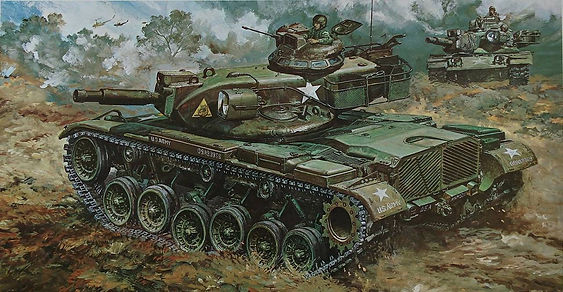
The M60A2 was an American main battle tank introduced in 1972 as a specialized variant of the M60 tank family. Nicknamed the “Starship” by its crews because of its advanced electronics and futuristic appearance, the tank featured a distinctive low-profile turret and a 152 mm gun/launcher system capable of firing both conventional rounds and the Shillelagh anti-tank guided missile. This design was intended to give the tank long-range anti-armor capability against heavily armored Soviet vehicles.
Although technologically ambitious, the M60A2 proved difficult to operate and maintain due to the complexity of its missile system and fire-control equipment. The tank served primarily with U.S. Army units in the 1970s before being gradually withdrawn from service. Despite its short operational life, the M60A2 represented an important experimental step in the development of modern fire-control systems and missile-equipped armored vehicles.
Manufacture:
152 mm gun/launcher
Caliber:
Chrysler Defense
Weight:
52 t
Panzer IV

The Panzer IV was a German medium tank introduced in 1937 and became one of the most important armored vehicles used by Germany during the Second World War. Initially designed as an infantry-support tank armed with a short-barreled 75 mm gun, it was later upgraded with a long-barreled 75 mm cannon capable of effectively engaging enemy armor. The tank operated with a five-man crew and featured a reliable and adaptable design.
As the war progressed, the Panzer IV evolved into the backbone of German armored forces, particularly after the limitations of lighter tanks became clear on the Eastern Front. Continuous upgrades in armor and firepower allowed the tank to remain competitive throughout much of the war, and more than 8,000 units were produced.
Manufacture:
75 mm
Caliber:
Krupp / Vomag
Weight:
25 t
SU-85

The SU-85 was a Soviet tank destroyer introduced in 1943 during the Second World War. Built on the chassis of the T-34 medium tank, it replaced the turret with a fixed armored casemate mounting an 85 mm anti-tank gun. This powerful weapon allowed Soviet forces to effectively engage newer German tanks such as the Panther and improved versions of the Panzer IV, which had proven difficult for earlier Soviet guns to defeat.
The vehicle retained the reliable mobility of the T-34 platform and operated with a four-man crew. While the fixed gun limited firing angles compared with turreted tanks, the SU-85’s strong firepower and relatively low profile made it an effective ambush and defensive vehicle. It served extensively on the Eastern Front until it was gradually replaced by the more heavily armed SU-100 later in the war.
Manufacture:
85
Caliber:
Uralmash
Weight:
29.6
T-34

The T-34 was a Soviet medium tank introduced in 1940 and widely regarded as one of the most influential armored vehicles of the Second World War. Designed by the Kharkiv Morozov Design Bureau, the tank combined strong sloped armor, a powerful main gun, and excellent mobility, giving it a major advantage over many early German tanks when it first appeared during Operation Barbarossa in 1941. Early versions were armed with a 76.2 mm gun, while later variants such as the T-34-85 mounted an 85 mm cannon that improved its effectiveness against heavier German armor.
Powered by a V-2 diesel engine producing about 500 horsepower, the T-34 offered good speed, reliability, and strong cross-country performance thanks to its wide tracks and rugged suspension. Its relatively simple design also allowed the Soviet Union to produce the tank in massive numbers, with more than 80,000 built during the war. The T-34 became the backbone of Soviet armored forces and played a critical role in battles such as Stalingrad, Kursk, and the final advance into Germany, helping shape the future design of modern main battle tanks.
Manufacture:
76.2
Caliber:
KhPZ
Weight:
26.5


T-84 Oplot-M


The T-84 Oplot-M is a modern Ukrainian main battle tank introduced in the early 2000s as the most advanced development of the Soviet-era T-80UD platform. Designed and produced by the Kharkiv Morozov Machine Building Design Bureau, the tank incorporates major improvements in firepower, protection, and battlefield electronics compared with earlier Soviet designs. The Oplot-M is armed with a 125 mm smoothbore cannon capable of firing conventional ammunition as well as guided anti-tank missiles, and it uses an autoloader that allows the tank to operate with a three-man crew.
Protection is provided by a combination of composite armor, explosive reactive armor (ERA), and modern defensive systems, including active countermeasures designed to defeat incoming missiles. Powered by a 1,200-horsepower diesel engine, the tank can reach speeds of around 70 km/h while maintaining good cross-country mobility. The T-84 Oplot-M represents Ukraine’s most advanced indigenous tank design and has been exported in limited numbers, most notably to Thailand, while also serving as a symbol of Ukraine’s continued armored vehicle development after the collapse of the Soviet Union.
Manufacture:
125 mm
Caliber:
Kharkiv Morozov Machine Building Design Bureau
Weight:
51 tons
AMX-40

The AMX-40 was a French main battle tank prototype developed during the 1980s as a next-generation export vehicle by GIAT Industries. Designed to compete on the international market, it featured composite armor, modern electronics, and a 120 mm smoothbore gun, along with a powerful diesel engine that provided excellent mobility. Although technically advanced, the AMX-40 failed to secure export customers and remained a prototype program.
Manufacture:
120 mm
Caliber:
GIAT Industries
Weight:
43 tons
Al-Zarrar

The Al-Zarrar is a Pakistani modernized main battle tank developed to upgrade older Chinese Type 59 tanks in service with the Pakistani Army. Introduced in the early 2000s and produced by Heavy Industries Taxila, the upgrade includes a 125 mm smoothbore gun, improved fire-control systems, composite armor, and explosive reactive armor to enhance survivability. The modernization allows Pakistan to extend the operational life of its existing armored fleet while improving battlefield performance.
Manufacture:
125 mm
Caliber:
Heavy Industries Taxila
Weight:
42 tons
Bernardini MB-3 Tamoyo


The Bernardini MB-3 Tamoyo was a Brazilian main battle tank project developed in the early 1980s by the company Bernardini. Based on a heavily modernized M41 Walker Bulldog chassis, the Tamoyo was intended to provide Brazil with an indigenous armored vehicle capable of replacing aging Cold War tanks. The design incorporated improved armor, upgraded fire-control systems, and a 90 mm or 105 mm main gun, but the project was eventually canceled before entering production.
Manufacture:
90 mm / 105 mm
Caliber:
Bernardini
Weight:
30 tons
Centurion

The Centurion was a British main battle tank introduced near the end of the Second World War and became one of the most successful tank designs of the early Cold War. Developed by Royal Ordnance, the Centurion combined strong armor protection, good mobility, and increasingly powerful guns, eventually mounting the highly effective 105 mm L7 cannon. The tank served with numerous countries around the world and remained in military service for decades, influencing many later tank designs.
Manufacture:
17-pdr / 20-pdr / 105 mm
Caliber:
Royal Ordnance / Vickers
Weight:
51 tons
M3 Stuart

The M3 Stuart was an American light tank introduced in 1941 and widely used by Allied forces during the early years of the Second World War. Designed for speed, reconnaissance, and infantry support, the Stuart was armed with a 37 mm main gun and several machine guns. It operated with a four-man crew and was valued for its mechanical reliability, good mobility, and relatively simple maintenance in field conditions.
Although its light armor and small-caliber gun limited its effectiveness against heavier enemy tanks, the M3 Stuart performed well in reconnaissance roles and in support of infantry units. The tank saw combat in multiple theaters including North Africa, the Pacific, and Europe, and it was also supplied to Allied nations through the Lend-Lease program. Its speed and dependability made it a respected vehicle among crews despite its limited firepower.
Manufacture:
37
Caliber:
American Car & Foundry
Weight:
12.7
Matilda II

The Matilda II was a British infantry tank introduced in 1939 and widely used during the early years of the Second World War. Known for its exceptionally heavy armor for the time, the Matilda II was highly resistant to most early German anti-tank weapons. It was armed with a 2-pounder (40 mm) gun and operated with a four-man crew, prioritizing protection and reliability over speed. Its thick armor made it particularly effective during the early stages of the war when many opposing tanks and anti-tank guns struggled to penetrate it.
The Matilda II saw extensive combat in the North African campaign, where it gained a strong reputation among Allied forces. During battles such as Operation Compass, its armor allowed British units to break through Italian defensive positions with relatively little loss. Although later German anti-tank guns eventually reduced its battlefield advantage, the Matilda II remained an important early-war tank and helped shape the development of heavily armored infantry support vehicles.
Manufacture:
40
Caliber:
Vulcan Foundry
Weight:
27
Panzer IV

The Panzer IV was a German medium tank introduced in 1937 and became one of the most widely produced and important armored vehicles used by Germany during the Second World War. Originally designed as an infantry-support tank armed with a short-barreled 75 mm gun, it was later upgraded with a longer high-velocity 75 mm cannon to improve its effectiveness against enemy armor. The tank typically operated with a five-man crew and featured a reliable chassis that allowed numerous upgrades throughout the war.
As the conflict progressed, the Panzer IV evolved into the backbone of German armored forces, particularly after the limitations of lighter tanks became clear on the Eastern Front. With improved armor and more powerful guns in later variants, the Panzer IV remained competitive against many Allied tanks and continued in production until the final months of the war. More than 8,000 units were built, and the tank served on every major front where German forces operated.
Manufacture:
75 mm
Caliber:
Krupp / Vomag
Weight:
25 t
Sho’t (Centurion)


The Sho’t was an Israeli version of the British Centurion main battle tank, introduced into service with the Israel Defense Forces in 1960. Israel acquired Centurion tanks from Britain and upgraded them with improved communications, fire-control equipment, and later more powerful engines. The tank was armed with the highly effective 105 mm L7 rifled gun, which gave it strong anti-armor capability.
The Sho’t became a key component of Israel’s armored forces and saw extensive combat in the Six-Day War (1967) and the Yom Kippur War (1973). Israeli crews valued the tank for its durability, firepower, and adaptability, and continued upgrades kept the platform effective for many years.
Manufacture:
105 mm
Caliber:
Israel Military Industries
Weight:
51 t
T-55 Enigma


The T-55 Enigma was an Iraqi modification of the Soviet-built T-55 main battle tank, developed during the early 1980s in response to heavy Iraqi armored losses during the Iran–Iraq War. Iraqi engineers sought to improve the survivability of their aging T-55 fleet against modern anti-tank weapons by adding large spaced armor boxes to the turret and hull. These external armor modules contained layered steel plates separated by air gaps, which helped disrupt the penetration of shaped-charge weapons such as RPGs and anti-tank missiles. The unusual blocky appearance of these armor additions led Western observers to give the tank the nickname “Enigma.”
Despite the additional protection, the T-55 Enigma retained the core characteristics of the original T-55, including the 100 mm D-10T rifled gun, a 580 horsepower diesel engine, and a four-man crew. The added armor significantly increased the vehicle’s weight and altered its silhouette but offered improved resistance to certain anti-tank threats. Only a small number of these upgraded tanks were produced, and they became widely known during the 1991 Gulf War, when coalition forces encountered and destroyed several examples in Iraqi service. Today, the T-55 Enigma stands as an example of improvised battlefield adaptation, illustrating how nations attempted to extend the combat effectiveness of older Cold War armored vehicles through localized upgrades.
Manufacture:
100 mm
Caliber:
Iraqi State Factories
Weight:
41 t
Tifon 2A


The Tifon 2A is a heavily modernized Romanian main battle tank based on The Soviet-era T-55, developed through a partnership between Romania’s defense industry and private contractors to effectively extend the operational life of its armored forces. It features significant mobility, firepower, and protection upgrades, including a new 850-horsepower diesel engine, an overhauled suspension system, and a NATO-standard 120mm smoothbore gun. Enhanced survivability comes from composite and modular armor, reactive armor blocks, a laser warning system, smoke launchers, and internal safety improvements. Advanced electronics such as a thermal imaging fire control system, laser rangefinder, automatic target tracking, and upgraded communications make the Tifon 2A capable of integrating into NATO operations. While not equal to the newest Western tanks, the Tifon 2A offers a competent and affordable modernization solution, reflecting a broader trend among former Warsaw Pact nations adapting legacy equipment to current standards.
Manufacture:
120 mm
Caliber:
UMB
Weight:
46 t