

Hanukkah and the Art of Asymmetric War


The Maccabean Revolt as a Campaign in Time, Strategy, and Memory
Hanukkah does not mark the start of a revolt or the end of a war. Instead, it highlights a key moment in a larger military struggle, when an insurgent group moved from just surviving to building real strength.
What stands out is not a miracle separate from conflict, but a campaign story that anyone studying asymmetric warfare would recognize.
175–168 BCE: The Strategic Context Takes Shape
The crisis that led to the Maccabean Revolt happened within a working imperial system. Antiochus IV Epiphanes took over a Seleucid Empire that was under pressure but not falling apart. The empire still had professional armies, garrisons, and strong administration. Judea held a sensitive spot in this system, both politically and culturally.
Imperial interference in religious practices did not happen in isolation. It connected with divisions among Judean elites—some accepted Hellenistic ways, while others saw them as harmful. This was important for military reasons. The empire faced a divided population, and its actions made these divisions worse instead of fixing them.
By the late 160s BCE, Seleucid rule had changed a social disagreement into a security issue. This is a common setup for insurgency: when forceful actions leave people with fewer choices and push them toward stronger identities.

167 BCE: The Spark and the Decision to Fight
The revolt did not begin with a planned uprising, but with a spark of resistance. Mattathias refused to follow imperial orders and then acted against collaborators, moving the situation from protest to armed defiance. In military terms, this moment is important not because of its size, but because it cannot be undone.
After violence breaks out, staying neutral becomes harder. The group that forms around Mattathias and his sons, especially Judah, is not yet an army. It is more like a network focused on survival. Their first goal is not to beat the Seleucids, but simply to avoid being wiped out.
This early stage sets the tone for the revolt. The rebels will not fight the empire in a traditional way. They will not try to hold territory too soon. Instead, they will give up stability in exchange for the ability to move quickly.
166–165 BCE: Insurgency and Survival Warfare
After Mattathias’ death, Judah Maccabee assumes leadership at a moment when the revolt could easily collapse. The forces available to him are small, lightly equipped, and dependent on local support. What they possess instead is speed, familiarity with terrain, and ideological cohesion.
During this phase, the revolt behaves like a textbook insurgency. Engagements are selective. Ambushes replace battles. Dispersal follows every strike. The Judean hill country becomes a weapon, neutralizing cavalry and forcing imperial troops into narrow routes where numerical superiority loses meaning.
The main goal during this time is to last. Every month the rebels survive, they gain more recruits, build their reputation, and make it more costly for the empire to stay. The Seleucid response becomes harsher and less focused. This uneven fight helps the rebels—not because they are stronger, but because they are harder to defeat.
By the end of this stage, the revolt has shown something important: force alone is not enough for the empire to regain control.
165 BCE: Escalation and the Defeat of Expeditions
The revolt’s most crucial military transition occurs when Judah Maccabee begins defeating organized Seleucid forces rather than merely avoiding them. This marks the move from small-scale resistance to having a real effect on the war. It is helpful to understand their significance. What matters is the pattern. Judah consistently forces engagements on unfavorable ground, strikes at moments of vulnerability, and disengages before imperial advantages can reassert themselves. The Seleucid system begins to suffer from decision paralysis. More force does not produce resolution. Each expedition raises costs without delivering finality.
Looking at it today, this is an example of decision-cycle warfare. Judah acts faster than the empire can respond. His wins are important not because he destroys armies, but because he changes what both sides expect. The empire might still win some battles, but it cannot end the war easily or at low cost.
At this point, the revolt becomes a real threat to Seleucid power.
Late 165 / Early 164 BCE: The March on Jerusalem
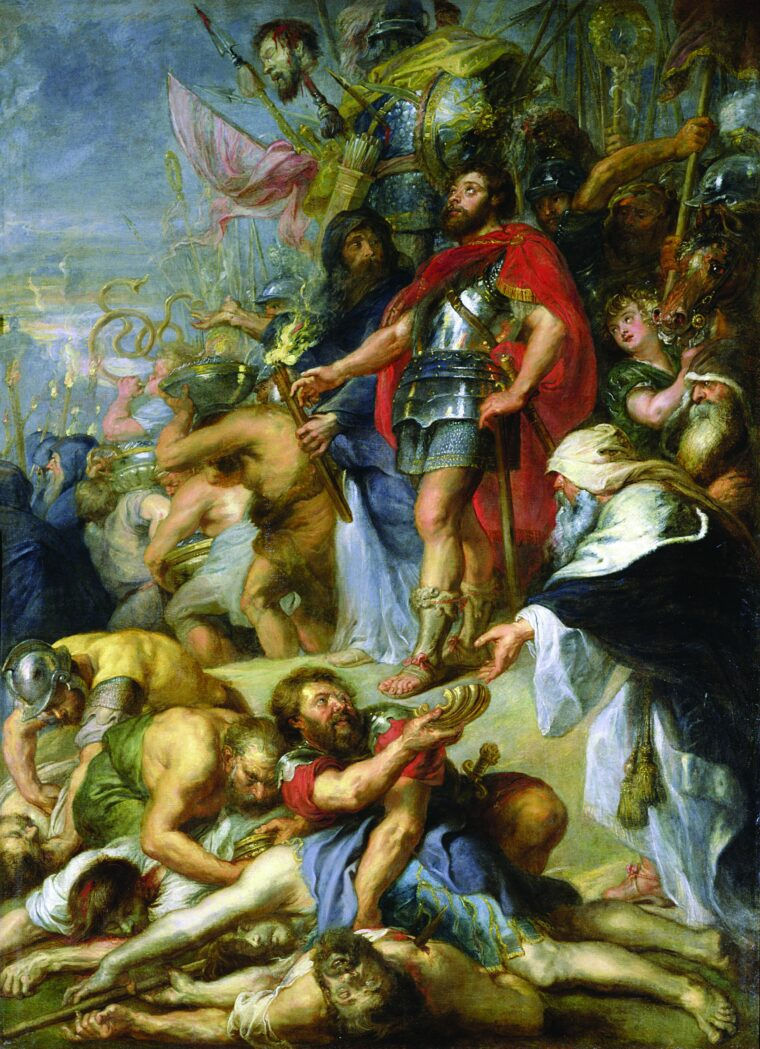
Choosing to march on Jerusalem is the revolt’s clearest strategic move. Judah does not try to free all of Judea or destroy the empire’s power. Instead, he focuses on the most important target.
Jerusalem, and especially the Temple, is more than just a place on the map. It is a center of power, meaning, and morale. Controlling the Temple gives a kind of legitimacy that winning battles alone cannot. By taking it, Judah turns military gains into real political change.
This choice shows that winning an uneven war is not about wearing down the enemy. It is about changing the purpose of the fight. After the Temple is taken back, the revolt is no longer just about resisting oppression. Now, it is about protecting a new order.
164 BCE: Rededication and Strategic Consolidation
The rededication of the Temple, which Hanukkah celebrates, happens after the fighting has already made a difference. From a military view, this ceremony is about securing gains, not starting them. It makes control official, sets the story in people’s minds, and ties legitimacy to tradition.
The eight-day observance does more than celebrate victory. It institutionalizes it. By fixing the event in time and practice, the revolt ensures that its achievement cannot be dismissed as a transient rebellion. Even if imperial forces return, they now confront a population unified around a restored center.
This is why Hanukkah is important from a strategy point of view. It turns one part of the campaign into a lasting symbol. The revolt is not over, but it has moved from just surviving to lasting over time.
After Hanukkah: War Continues, Memory Endures
The Seleucid–Hasmonean conflict did not end in 164 BCE. Fighting went on, alliances changed, and politics kept shifting. Still, Hanukkah stands out in memory because it marks the moment when survival became a lasting presence. The oil rather than the battles themselves. From a military history perspective, this reflects successful post-war narrative stabilization. The community no longer needs to rehearse violence to preserve identity. The lesson has already been secured.
Why the Timeline Matters
Seen in sequence, the Maccabean Revolt illustrates enduring principles of warfare:
Insurgencies are born in political fracture, not unity.
Survival precedes victory
Time functions as a strategic weapon.
Legitimacy can outweigh territorial control.
Memory, once institutionalized, becomes a force multiplier.
Hanukkah lasts because it marks the exact moment when these ideas came together. It is not a story separate from war, but one shaped by it, improved over time, and remembered because it succeeded.


Comments