

Alexander the Great and the Theory of War: Comparing Sun Tzu, Clausewitz, and Jomini


Alexander the Great never wrote down his ideas about war. He left a manual or treatise, and he never explained his methods in detail. Still, centuries later, many military thinkers described ideas that Alexander utilized in practice on the battlefields of Asia. When we compare Alexander to Sun Tzu, Clausewitz, and Jomini, we see that these theorists often wrote about principles Alexander had already applied instinctively.
Alexander fought at a time when military theory did not exist as a formal field. Sun Tzu focused on harmony and deception, Clausewitz looked for meaning in chaos, and Jomini tried to turn war into a science. Alexander, on the other hand, faced real enemies, unreliable information, tired soldiers, and political goals that required him to keep winning. His campaigns connect the practical experience of ancient battles with later efforts to explain how war works.
The Shadow of Sun Tzu: Winning Before the Battle Begins

Sun Tzu argued that the greatest commander wins before fighting begins. Victory, in his view, emerges from shaping conditions so completely that the enemy collapses psychologically before swords meet. For him, victory comes from molding the situation so well that the enemy gives up mentally before any battle begins. He saw war as relying on deception, speed, and control over what the enemy thinks. He rarely allowed opponents to dictate terms. Before crossing into Asia, he secured Greece. Before confronting Persia’s main armies, he dismantled coastal resistance and denied the Persian fleet secure bases. Each campaign phase prepared the next, narrowing the enemy's options long before the decisive battle.
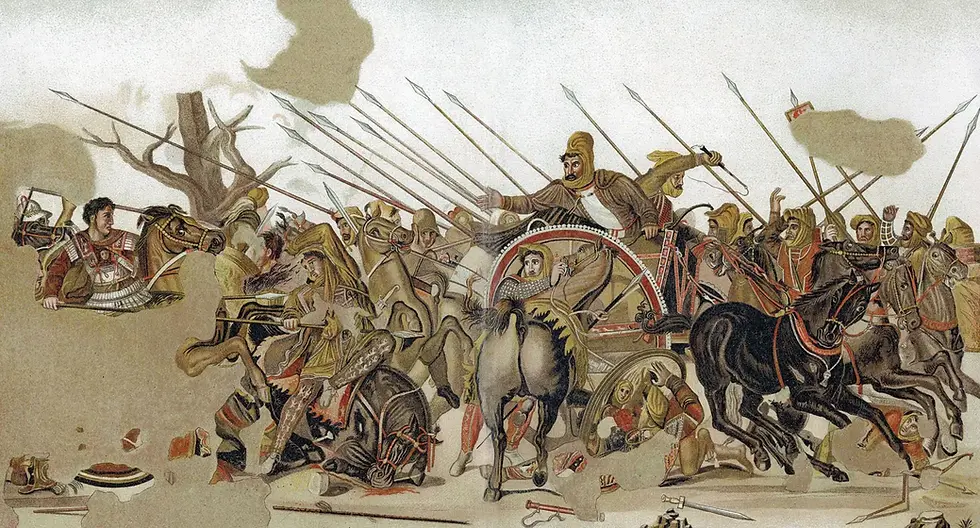
At Gaugamela, Alexander was outnumbered, but he did not fight the direct battle Darius wanted. Instead, he moved sideways, stretching the Persian lines until gaps appeared. He waited to attack until the right moment. The outcome depended more on confusion and timing than on sheer force. When Alexander attacked Darius directly, the Persian army fell apart, turning a tactical move into a psychological defeat.
Alexander differed from Sun Tzu in that he was willing to risk large, decisive battles. Sun Tzu wanted to win with as little destruction as possible. Alexander thought a single, decisive fight could end a war for good. He used deception not to avoid fighting, but to make sure the battle would settle everything.
Alexander and Clausewitz: War as Political Transformation
If Sun Tzu explains how Alexander fought, Clausewitz helps explain why he fought the way he did.
Clausewitz said that war is a continuation of politics, formed by emotion, uncertainty, and the clash of different wills. Alexander’s campaigns clearly fit this idea. He did not just want to conquer for the sake of wealth. He wanted to be seen as the rightful ruler of Persia and to build a new empire.
Every battle Alexander fought had political meaning. At Issus and Gaugamela, he broke Darius III’s authority via defeating his armies. Alexander knew that shaking Persian confidence was more important than destroying their armies. Once the empire’s legitimacy was gone, cities gave up with little fight.
Clausewitz also discussed “moral forces,” such as leadership and morale, which can matter more than numbers. Alexander showed this in action. He led from the front, shared hardships with his men, and built strong loyalty among his soldiers, even during tough campaigns in the east. His presence helped his army make quick decisions and stay steady in hard times.
But Alexander was different from Clausewitz in one important way. Clausewitz thought that friction, uncertainty, and problems were always part of war. Alexander acted as if he could beat friction by keeping up his momentum. He used speed to deal with chaos. By moving faster than his enemies, he cut down on uncertainty instead of just putting up with it.
The Commander Jomini Wanted to Explain

Later, when Jomini tried to organize warfare around principles such as decisive points, lines of operation, and concentration of force, he described patterns that resembled Alexander’s campaigns.
Alexander always moved toward key locations. He made sure to control river crossings, forced his enemies into bad positions, and used his best cavalry at just the right moments. His actions showed a sense of battlefield space that Jomini later sought to codify.
Yet Alexander never fought according to rigid formulas. He adapted constantly, blending siege warfare, diplomacy, rapid maneuver, and cultural unification as circumstances dictated. Where Jomini sought predictable rules, Alexander relied on judgment determined by experience and intuition.
Alexander represents the living reality behind Jominian theory: principles exist, but success depends on knowing when to break them.
Amid Theory and Practice
Seen together, the comparison shows something deeper about military thought itself.
Sun Tzu describes war as an intellectual contest defined by perception.
Clausewitz portrays it as a political struggle governed by human will.
Jomini attempts to make it a science governed by structure.
Alexander used elements of all three approaches, even though he did not intentionally follow any of them. He used deception like Sun Tzu, aimed for political goals like Clausewitz, and moved with the precision Jomini described. But none of these theories fully explain him, because theories look for stability, while Alexander succeeded by staying in motion.
His genius did not lie in inventing a single method but in combining strategy, operations, and leadership into a unified tempo of war. Opponents continually reacted while Alexander dictated events.
The Enduring Lesson
Alexander’s campaigns demonstrate that military theory regularly emerges after great commanders reveal what is possible. The theorists explain patterns; commanders create them.
Sun Tzu teaches commanders how to form an advantage.
Clausewitz explains the forces that drive conflict.
Jomini organizes victory into principles that can be taught.
Alexander shows how all three converge in practice, with vision, speed, and leadership combining under decisive command.
He did not write the theory of war. He lived it, and later generations have spent two thousand years trying to explain why it worked.
Bibliography
Primary Sources (Ancient Accounts)
Arrian. The Campaigns of Alexander. Translated by Aubrey de Sélincourt. Revised edition by J. R. Hamilton. London: Penguin Classics, 1971.
Curtius Rufus, Quintus. The History of Alexander. Translated by John Yardley. London: Penguin Classics, 1984.
Diodorus Siculus. Library of History, Book XVII. Translated by C. Bradford Welles. Cambridge, MA: Harvard University Press, 1963.
Plutarch. The Age of Alexander: Nine Greek Lives. Translated by Ian Scott-Kilvert. London: Penguin Classics, 1973.
Modern Studies on Alexander and Macedonian Warfare
Engels, Donald W. Alexander the Great and the Logistics of the Macedonian Army. Berkeley: University of California Press, 1978.
Fuller, J. F. C. The Generalship of Alexander the Great. New York: Da Capo Press, 1960.
Goldsworthy, Adrian. Philip and Alexander: Kings and Conquerors. New York: Basic Books, 2020.
Green, Peter. Alexander of Macedon, 356–323 B.C.: A Historical Biography. Berkeley: University of California Press, 1991.
Lonsdale, David J. Alexander the Great: Lessons in Strategy. London: Routledge, 2007.
Classical Military Theory
Clausewitz, Carl von. On War. Edited and translated by Michael Howard and Peter Paret. Princeton, NJ: Princeton University Press, 1984.
Jomini, Antoine-Henri. The Art of War. Translated by G. H. Mendell and W. P. Craighill. Philadelphia: J. B. Lippincott, 1862.
Sun Tzu. The Art of War. Translated by Samuel B. Griffith. Oxford: Oxford University Press, 1963.
Comparative Strategy and Military Thought
Hanson, Victor Davis. The Western Way of War: Infantry Battle in Classical Greece. Berkeley: University of California Press, 1989.
Keegan, John. A History of Warfare. New York: Vintage Books, 1994.
Paret, Peter, ed. Makers of Modern Strategy: From Machiavelli to the Nuclear Age. Princeton, NJ: Princeton University Press, 1986.
Bosworth, A. B. Conquest and Empire: The Reign of Alexander the Great. Cambridge: Cambridge University Press, 1988.
Worthington, Ian. By the Spear: Philip II, Alexander the Great, and the Rise and Fall of the Macedonian Empire. Oxford: Oxford University Press, 2014.

Comments