


95
HMS Hermes



Design and Construction
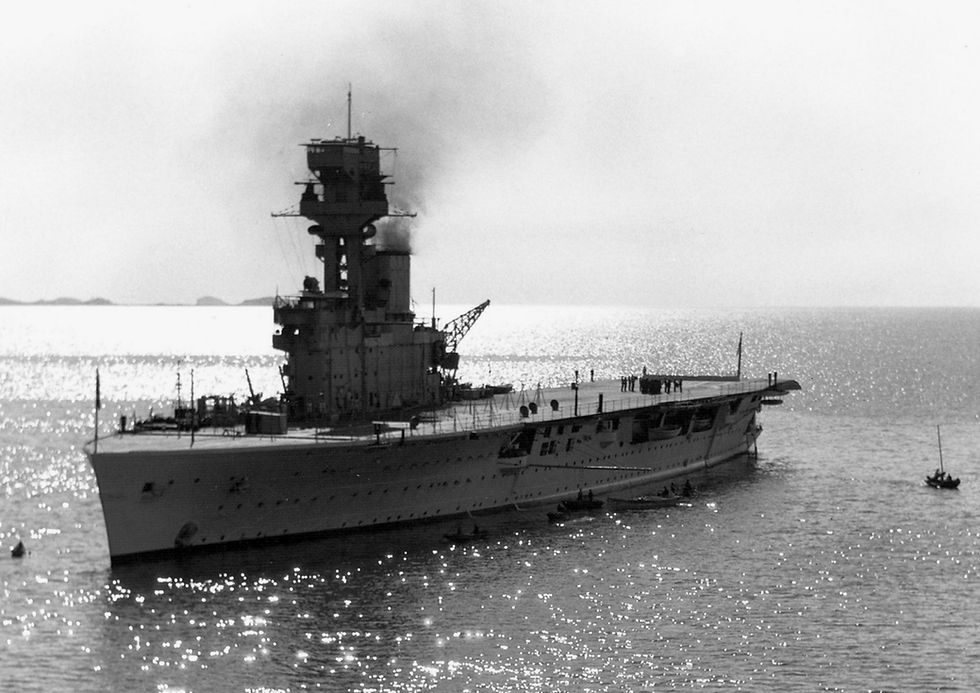
The British carrier Hermes represented the Royal Navy’s first purpose-built aircraft carrier design. Ordered in 1917 during the First World War, she launched in 1919 and commissioned in 1924.
Unlike early experimental carriers converted from existing ships, Hermes incorporated aviation features from the start. Her design included a full-length flush flight deck, a starboard island superstructure, and internal hangars connected by aircraft elevators.
The ship displaced roughly 10,800 tons standard, measured about 600 feet in length, and achieved speeds of 25 knots. Her air group typically consisted of 15 to 20 aircraft, including fighters, reconnaissance planes, and torpedo bombers.
Although small by later standards, the design proved highly influential. The island layout and flight deck configuration became the standard for future carriers around the world.
Interwar Operations
Throughout the 1920s and 1930s, Hermes served widely across the British Empire, operating in the Mediterranean, Atlantic, and Far East. During this period the Royal Navy refined carrier doctrine, including deck landing procedures, aircraft coordination with surface fleets, and reconnaissance missions.
Because she was smaller than later carriers such as HMS Ark Royal (91), Hermes often served as a training carrier or colonial patrol vessel. Nevertheless, the ship provided valuable operational experience in carrier aviation.
Early World War II Service
When World War II began in 1939, Hermes joined Allied naval forces operating in the Indian Ocean and Atlantic. Her aircraft conducted patrol missions, anti-submarine sweeps, and convoy escort operations.
During this period the carrier supported operations against Axis commerce raiders and protected sea lanes vital to the British Empire. However, her small size limited her air group and defensive capability compared to newer fleet carriers.
Loss in the Indian Ocean Raid
In April 1942 the Imperial Japanese Navy launched a major carrier strike against British naval forces in the Indian Ocean under Admiral Chūichi Nagumo.
On 9 April 1942, Japanese carrier aircraft discovered Hermes near Batticaloa. Without fighter cover, the ship became highly vulnerable to air attack. Waves of Japanese dive bombers struck the carrier, scoring numerous hits in a short period.
The attack proved devastating. Hermes capsized and sank within minutes, becoming the first aircraft carrier ever sunk solely by carrier-based aircraft.
Historical Significance
Hermes represents an important transitional stage in carrier development. Her design integrated several key elements—an island superstructure, elevators, and a flush flight deck—that became standard in future carriers worldwide.
Although small and lightly protected compared to later fleet carriers, Hermes demonstrated the strategic potential of naval aviation and helped the Royal Navy develop operational procedures that shaped carrier warfare during World War II.
Builder
Speed
Type
Complement
aircraft carrier
Accomodations
Commission date
1924
Displacemen
10850
Motto
Homeport
Propulsion-1 |
|---|